If you are planning to build a successful career abroad, you have likely looked into the Middle East or Europe. However, if you want a destination with incredibly high salaries, world-class living standards, and excellent labor rights, South Korea should be at the top of your list.
Every year, thousands of Bangladeshi workers migrate to South Korea legally and send massive amounts of remittances back home. With the upcoming economic demands in 2026, the Korean government is highly interested in recruiting both general laborers and highly skilled tech professionals from Bangladesh.
But here is the most important part: choosing the right visa path is critical. If you choose the wrong method, you might lose money to scammers.
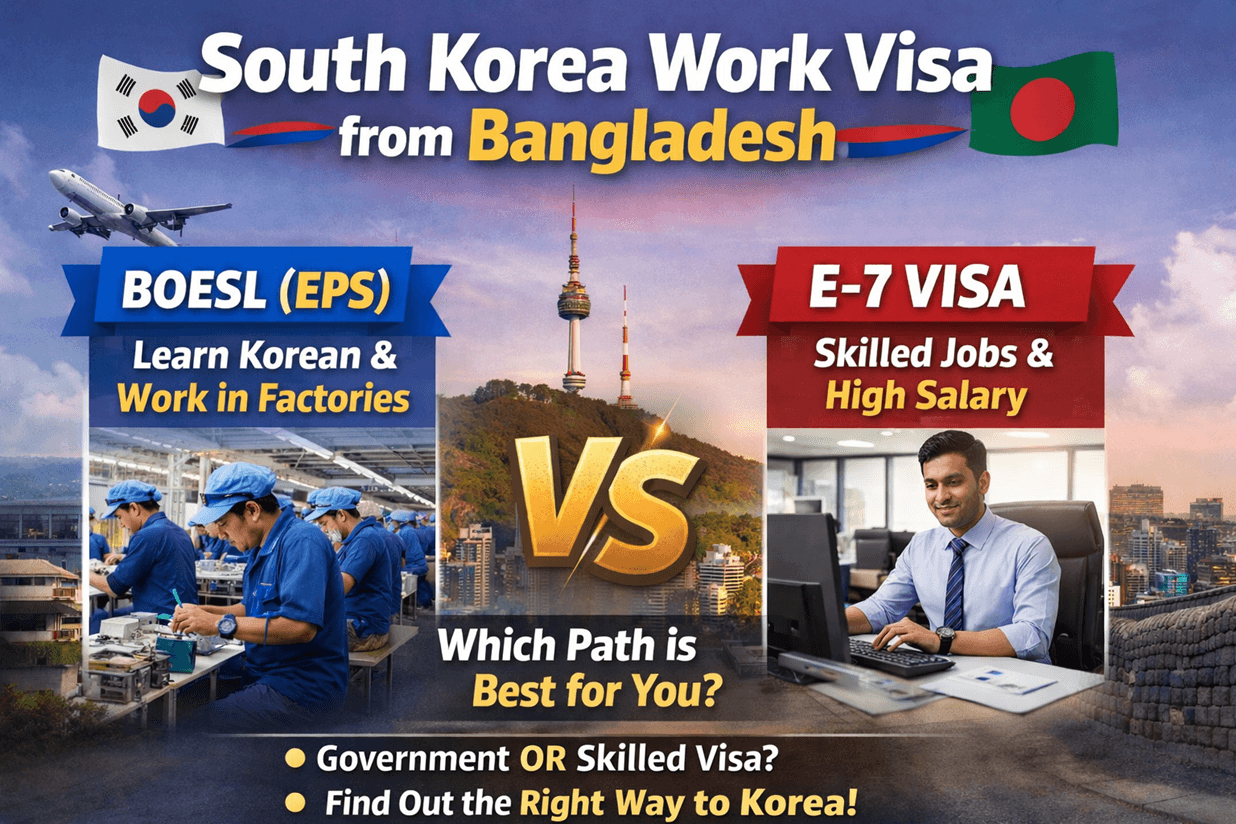
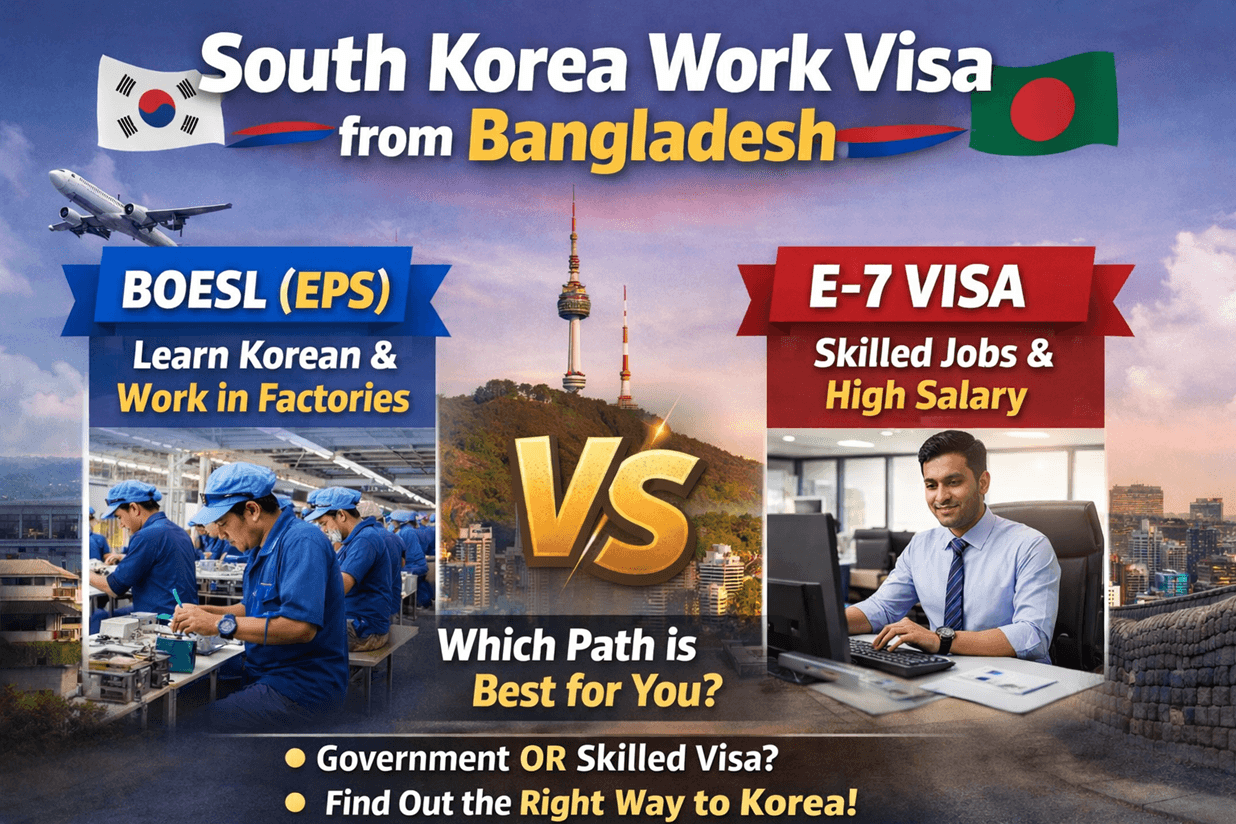
If you are going to South Korea from Bangladesh, there are mainly two legal and safe ways: the BOESL (EPS System) and the E-7 Visa. This comprehensive guide will explain both options in a very simple, step-by-step, and easy-to-read format.
Why Choose South Korea in 2026?
South Korea is currently one of the best countries for Bangladeshi workers. It is not just about the K-pop culture or beautiful cities; it is about pure financial growth.
-
Extremely High Salaries: The minimum wage in South Korea is heavily regulated. You will earn significantly more than in many Middle Eastern or Southeast Asian countries.
-
Excellent Work Environment: Korean labor laws strictly protect foreign workers. You get exact working hours, proper rest days, and mandatory safety gear.
-
Massive Overtime Opportunities: If you are willing to work hard, overtime (OT) pay in Korea is fantastic, often doubling your basic monthly income.
-
Halal Food and Community: There is a large, established Bangladeshi community in cities like Seoul and Ansan, complete with mosques and halal Bengali restaurants.
The Two Main Legal Pathways to South Korea
To keep things simple, the Korean government has divided foreign workers into two main categories:
-
BOESL (EPS System): Designed for general workers, factory labor, and agriculture.
-
E-7 Visa: Designed for skilled professionals, engineers, and IT experts.
Let us explore both options in detail.
Pathway 1: BOESL (EPS System) – The Government Route
What is BOESL and EPS?
BOESL stands for Bangladesh Overseas Employment and Services Limited. It is a strictly monitored government organization in Bangladesh.
EPS means Employment Permit System. It is a direct “Government-to-Government” (G2G) agreement. This means the Korean government directly asks the Bangladesh government for workers. There are absolutely no private agencies or “dalals” (middlemen) allowed in this process. It is 100% safe.
What is the EPS-TOPIK Exam?
You cannot go to Korea under the EPS system without learning their language. EPS-TOPIK (Test of Proficiency in Korean) is the official Korean language exam.
Because you will be working in Korean factories or farms, you need basic language skills to understand instructions and stay safe. Passing this exam is mandatory.
Jobs Available Under BOESL
The EPS system recruits for general labor roles. You do not need a university degree for these:
-
Manufacturing and Factory Jobs (Garments, Plastics, Electronics)
-
Construction Work
-
Agriculture and Farming
-
Shipbuilding and Heavy Industry
Step-by-Step Process for BOESL (EPS)
-
Step 1: Learn the Korean Language. Do not wait for a circular. Start learning basic Korean today. There are hundreds of excellent EPS training centers across Bangladesh.
-
Step 2: Apply for the Exam. When BOESL publishes the official circular (usually early in the year), register online.
-
Step 3: Pass EPS-TOPIK. You must sit for the computer-based test. It includes reading and listening sections.
-
Step 4: The Skill Test. After passing the language test, you will face a basic physical and skill test to prove you can handle manual labor.
-
Step 5: Entering the Job Roster. Your profile is uploaded to a database. Korean employers log in and select workers from this list.
-
Step 6: Job Offer and Flight. If a Korean boss selects you, you will sign a contract. BOESL will handle your visa processing, and you will fly to South Korea!
Salary and Benefits (BOESL)
-
Average Basic Salary: 1,800 to 2,500 USD per month.
-
In Bangladeshi Taka (BDT): Roughly 2 Lakh to 3 Lakh BDT per month!
-
With regular overtime, many Bangladeshi EPS workers earn over 3.5 Lakh BDT monthly.
Pros and Cons of BOESL
Advantages: 100% safe government system, extremely low processing cost, no high education required, and amazing earning potential. Disadvantages: Learning Korean takes months of hard work, the competition in Bangladesh is incredibly high, and you may have to wait on the roster for a long time to get picked.
Pathway 2: E-7 Visa – The Skilled Professional Route
What is the E-7 Visa?
While the EPS system is for general labor, the E-7 Visa is South Korea’s premier visa for highly skilled foreign professionals.
South Korea is a global tech hub. Companies like Samsung, Hyundai, and LG constantly need brilliant minds. If you have a professional university degree and real-world experience, the E-7 visa allows you to work in corporate or specialized technical environments.
Who Can Apply for the E-7 Visa?
This visa is heavily regulated. You cannot apply if you are an unskilled worker. It is strictly suitable for:
-
IT Professionals and Software Developers
-
Mechanical and Electrical Engineers
-
Specialized Technicians (e.g., Expert Welders for Shipbuilding)
-
High-level Diploma or Bachelor’s Degree holders.
Requirements for the E-7 Visa
-
A Direct Job Offer: You cannot apply for the visa first. You must secure a confirmed job offer from a Korean company willing to sponsor you.
-
Education: A relevant Bachelor’s degree or a highly specialized Diploma.
-
Experience: Usually, 1 to 5 years of proven work experience in your specific field.
-
Documents: A professional CV, experience letters, university certificates, and a valid passport.
Step-by-Step Process for the E-7 Visa
-
Step 1: Prepare Your Portfolio. Improve your professional skills (coding, engineering software, etc.).
-
Step 2: Create a Global CV. Make a strong, international-standard resume highlighting your specific technical skills.
-
Step 3: Apply Online. Use platforms like LinkedIn, Glassdoor, or official Korean job portals to apply directly to companies. (Some legal specialized agencies also recruit for E-7).
-
Step 4: Ace the Interview. You will likely face multiple online video interviews with Korean HR managers.
-
Step 5: Visa Sponsorship. If you pass the interview, the company will issue an official employment contract and sponsor your E-7 visa. You then submit your documents to the South Korean Embassy in Dhaka.
Salary and Benefits (E-7)
-
Average Salary: 2,500 to 5,000 USD per month (or much more).
-
In Bangladeshi Taka (BDT): Roughly 3 Lakh to 6 Lakh+ BDT per month.
-
E-7 visa holders enjoy a white-collar lifestyle, incredible corporate bonuses, and a clear pathway to permanent residency (F-2 or F-5 visas).
Pros and Cons of the E-7 Visa
Advantages: Very high corporate salary, excellent career growth, no strict requirement to pass the EPS-TOPIK language test, and you can eventually bring your family. Disadvantages: Securing a direct job offer from Bangladesh is very difficult, requires high-level skills, and there is a risk of fake job offer scams online.
Quick Comparison: BOESL (EPS) vs. E-7 Visa
To make your decision easier, here is a quick head-to-head comparison:
| Feature | BOESL (EPS System) | E-7 Visa |
| Worker Type | General Worker / Labor | Skilled Professional / IT |
| Language Rule | Must pass EPS-TOPIK | Not mandatory (but helpful) |
| Education Level | Basic education is enough | Bachelor’s Degree / Diploma |
| Average Salary | Medium to High (With OT) | Very High (Corporate Package) |
| Processing Cost | Very Low (Govt. fees only) | Medium |
| Difficulty Level | High competition for language test | High difficulty to get job offer |
| Can Bring Family? | No | Yes (Under certain conditions) |
Which One Should You Choose?
Choose BOESL (EPS) if:
-
You are a beginner entering the job market.
-
You do not have a specialized university degree or IT skills.
-
You want a highly secure, low-cost migration method.
-
You have the patience to sit down and study the Korean language for 6 months.
Choose the E-7 Visa if:
-
You are an experienced Software Engineer, Mechanical Engineer, or tech expert.
-
You want a high-paying corporate salary rather than factory wages.
-
You have excellent English communication skills to crack international interviews.
-
You know how to safely navigate online job portals to find genuine employers.
Important Warning for Bangladeshi Job Seekers
Whenever there is money involved, there are scammers. Please follow these strict rules to protect yourself:
-
Never use a “Dalal” for EPS: EPS is 100% controlled by BOESL. Anyone asking for 10-15 Lakh Taka claiming they can give you an “EPS Visa without an exam” is a fraud.
-
Verify E-7 Offers: If an online agency sends you an E-7 job offer, verify the company’s existence. Do not pay massive advance fees for an offer letter.
-
Stay Updated: Always check the official BOESL Facebook page and website for real circulars and updates.
Final Thoughts
Migrating to South Korea is one of the smartest financial decisions a Bangladeshi worker can make in 2026. Whether you choose the hardworking path of the BOESL (EPS) system or leverage your technical expertise for the E-7 Visa, your future in South Korea can be incredibly bright.
Take the time to evaluate your own skills. If you are a general worker, go buy a Korean language book today. If you are an engineer, start updating your LinkedIn profile. Your Korean dream is highly achievable if you follow the right legal path!
Frequently Asked Questions (FAQs)
Q: Do I need an agency to apply for the BOESL EPS system? A: Absolutely not. BOESL manages the entire process. Private agencies are strictly prohibited from processing EPS visas.
Q: Can a female candidate apply for South Korea from Bangladesh? A: Yes! Female candidates can apply through both the BOESL system (usually for manufacturing/garments) and the E-7 skilled visa.
Q: How much does it cost to go through BOESL? A: The government processing cost is incredibly low. Including medical tests, training, and flight tickets, it generally costs a fraction of what private agencies charge for Middle Eastern visas.
Q: Can I change from an EPS visa to an E-7 visa later? A: Yes! This is a popular route. If you enter Korea on an EPS visa (E-9), learn the language perfectly, and gain technical skills, the Korean government allows you to upgrade to an E-7-4 (Skilled Worker) visa.
Q: Is IELTS required for the E-7 Visa? A: IELTS is not a strict legal requirement for the visa itself. However, to pass the job interview with a Korean company, you must speak fluent English, so having a good English background is essential.